and Stop Remote Hiring Fraud (Without Overreacting)
Deepfakes, proxy interviews, and AI-assisted cheating are no longer fringe concerns in remote hiring. Video tools are more convincing than ever, candidates have more ways to misrepresent themselves, and recruiters are increasingly being asked to catch problems they were never trained to spot. The answer is not paranoia. It is to build a smarter interview process that helps recruiters spot risk early without turning the experience into an interrogation.
Why Deepfake Interview Fraud Is Growing in Remote Hiring
A few years ago, most interview fraud sounded like an edge case. This has changed fast. Between 2023 and 2024, deepfake fraud attempts in hiring jumped by 1,300%, with that trajectory continuing to accelerate through late 2025. AI-generated faces and voices are now more convincing, real-time video filters are widely available, and the old assumption that “if they showed up on video, they must be real” simply does not hold anymore.
| 1,300% |
Increase in deepfake fraud attempts in hiring between 2023 and 2024, with the trend accelerating through late 2025. Source: Pindrop, 2025 Voice Intelligence & Security Report |
The scale of the problem is no longer theoretical. A 2025 Greenhouse survey of 4,136 hiring managers found that 31% have personally interviewed a candidate they suspected — or confirmed — was using a fake identity via deepfake technology. Looking ahead, Gartner predicts that by 2028, one in four job candidates worldwide will be a “fake” or synthetic persona.
This matters most in IT hiring, where remote interviews are the norm and technical roles are often filled quickly. Fraud does not just waste time. It can lead to bad hires, security risk, project delays, and lasting damage to client trust. For staffing firms, the stakes are even higher; you are not just screening for a role, you are putting your name behind the person you place. Recruiters need a process that identifies problems without punishing legitimate candidates who are simply nervous, camera-shy, or not polished on video.
What AI Interview Cheating Actually Looks Like
Interview cheating is not always dramatic. Sometimes it is subtle and easy to miss. A candidate may use a deepfake video filter, route audio through another person, have someone else answer the interview for them, or quietly rely on AI help from a second device while pretending to answer on the spot.
In technical roles specifically, nearly half of all candidates in Software Engineering and Data Science have been flagged for using AI-powered assistance during interviews — a rate four times higher than in sales roles. More concerning still, approximately 61% of candidates using AI tools score above passing thresholds, often appearing more qualified and confident than honest applicants because AI mimics the exact rubrics hiring managers apply. And 79% of this cheating uses invisible overlays or dedicated assistant tools that traditional screen-sharing monitors cannot detect.
| 48% |
Of candidates in technical roles (Software Engineering, Data Science, etc.) flagged for AI-assisted cheating — 4x the rate of sales roles. Source: Fabric, State of AI Interview Cheating in 2026 (19,368 interviews) |
The common thread is misrepresentation. The candidate is trying to appear more skilled, more qualified, or more consistent than they really are. In staffing, that is especially dangerous because you are representing that person to a client. If the candidate is fake or heavily assisted, your client relationship takes the hit.
Deepfake Red Flags Recruiters Should Watch For
There is no single giveaway and that is important to remember. A rough interview can still involve a legitimate candidate, and nerves can make even strong candidates look off. But when several signals appear together, it is worth slowing down.
Common deepfake and fraud red flags in remote interviews:
- Overly polished answers that lack specific supporting detail;
- Inconsistent tone, vocabulary, or confidence level across questions;
- Noticeable audio lag or mismatch between lip movement and speech;
- Unusual or unnatural eye movement patterns;
- Visual artifacts around the hairline, jawline, or edges of the face;
- Inability to explain the actual decisions, tradeoffs, or mistakes in a project;
- Repeated use of generic phrases when asked follow-up questions;
- Hesitation or deflection when asked to name specific tools, teammates, or timelines.
One of the strongest signals is when a candidate cannot go beyond a scripted headline. They may describe the outcome of a project but struggle to explain how they got there. Real experience usually comes with detail. Fake or assisted answers tend to stay generic.
Interview Questions That Expose Fake or AI-Assisted Candidates
The best defense against interview fraud is better interviewing. Good questions do more than test knowledge. They make it genuinely hard to fake real experience.
Ask the candidate to walk you through a recent project step by step: not the summary version, the actual process. Ask what they did first, what went wrong, who they worked with, and what they would change next time. Then follow up with “why” and “how” questions. Those are much harder to fake than surface-level questions.
Shift from theory to application. Instead of asking what a cloud engineer should know about migration, ask how they would handle a messy migration with limited downtime and poor documentation. That forces the candidate to think in real time. A short live scenario or whiteboard exercise can also be useful, especially for technical roles where actual problem-solving matters more than memorized answers.
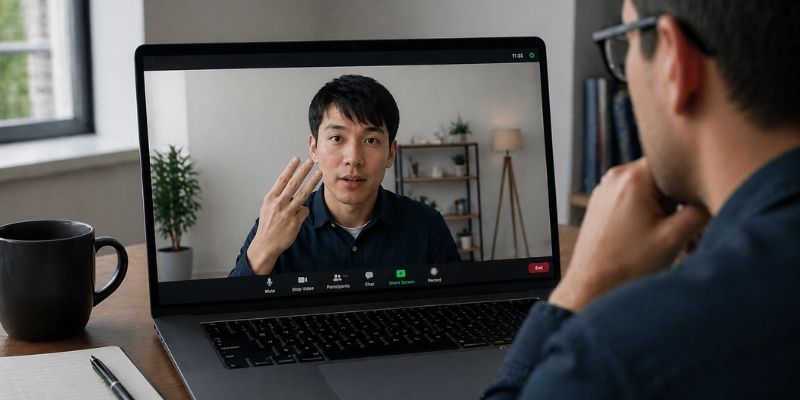
Asking a candidate to turn their camera slightly, adjust lighting, or share their screen mid-interview can also be revealing. Lower quality deepfake filters often break under those conditions.
Simple Identity Verification Steps for Remote Interviews
You do not need a heavy-handed security process to meaningfully reduce fraud risk. A few basic steps go a long way.
Start with identity verification early. Request a government-issued ID as part of pre-screen onboarding. Frame it as a standard process, not suspicion. Many legitimate verification platforms handle this professionally and unobtrusively.
Use structured interviews. When every candidate is asked the same core questions, inconsistencies are much easier to detect. It also reduces bias and makes your process more defensible.
Bring in a second interviewer for high-stakes roles. Two observers catch different signals. A single person is not making the call alone — and it is harder for a coached or AI-assisted candidate to manage two interviewers simultaneously.
Cross-check resume claims during the interview itself. If a candidate lists a deployment, ask what tools they used, what their specific contribution was, and who else was on the team. Real candidates answer with context. Fake candidates often drift into vague language or repeat the same phrases.
Consider live technical assessments. For IT roles, tools that require real-time problem-solving — not take-home assignments — significantly raise the difficulty of cheating. Shared coding environments where you can observe keystrokes and process are particularly effective. This is not just best practice: Google reintroduced in-person technical interview rounds specifically to counter AI interview fraud, a move confirmed in multiple industry reports through 2025.
Common Mistakes Recruiters Make When Screening for Interview Fraud
It is easy to overcorrect and that usually makes the process worse.
Do not accuse someone based on one odd pause or a bad internet connection. Do not confuse nerves with fraud. Some strong candidates are simply awkward on video or unaccustomed to high-pressure interviews. A hostile process damages the candidate experience and can cost you qualified people.
The goal is not to “catch” everyone. The goal is to reduce risk using multiple signals evaluated together. One strange answer should prompt a better follow-up, not an immediate conclusion.
How Staffing Firms Can Protect Hiring Quality Against Interview Fraud
The financial exposure from getting this wrong is real. According to hiring fraud researchers at Fabric, the direct cost of a fraudulent hire, factoring in re-recruitment, wasted onboarding, and the security risk of giving a bad actor access to internal systems, routinely exceeds $50,000 per incident.
| >$50K |
Direct cost per fraudulent hire, including re-recruitment, onboarding waste, and insider security exposure. Source: Fabric, State of AI Interview Cheating in 2026 |
A newer and more alarming pattern involves what fraud researchers are calling the “Multi-Hired Ghost”: scammers using deepfake audio and video to pass interviews for multiple full-time remote roles simultaneously, then using AI agents to automate their actual work output. For IT staffing firms, this is a direct threat to client trust and contract integrity.
The strongest process is layered. Use structured interviews, live follow-ups, and clear role-specific questions that require real experience for good answers. Train both recruiters and hiring managers to look for patterns, not just isolated cues. Above all, make sure everyone involved knows what a normal interview looks like for that role. Warning signs are easier to spot when you have a clear baseline.
For staffing firms specifically, this is also about protecting client relationships. A better screening process improves placement quality, reduces wasted interview cycles, and builds confidence with clients who are trusting you to vet candidates they will never meet before an offer is extended. That trust is especially hard to rebuild in IT staffing, where bad placements are expensive and project timelines do not wait.
Where Fraud Hits Hardest
Not all roles carry equal exposure. Software Engineering and Data Science positions face the highest fraud risk, driven by the availability of real-time AI coding assistants and the fully remote nature of most technical screenings.

The consensus for 2026 is that identity verification must move to the very start of the hiring funnel, and that “live challenge” tests, including unexpected environmental changes mid-interview, are no longer optional for tech recruiters.
Frequently Asked Questions
Can you detect a deepfake during a live video interview?
Not always with certainty, but there are practical tells. Lip-sync lag, unnatural blinking, and visual inconsistencies around the hairline and jawline are common indicators. Asking a candidate to turn slightly, adjust their lighting, or move to a different position mid-interview can disrupt lower-quality filters. Combining visual observation with follow-up questions that require specific recall is more reliable than any single technique.
What is the difference between a deepfake and a proxy interview?
A deepfake uses AI to alter or replace a person’s face or voice in real time during a video call. A proxy interview involves a different person physically conducting the interview on the candidate’s behalf, sometimes while the actual candidate listens in through an earpiece. Both are forms of identity fraud, but they require different detection approaches. Deepfakes tend to produce visual and audio artifacts. Proxy interviews are more likely to surface through knowledge gaps and inconsistency between resume claims and spoken answers.
How common is interview fraud in IT hiring?
A: Reports from staffing and HR technology firms suggest it has increased significantly since 2022, particularly in fully remote technical roles. A 2025 Greenhouse survey of 4,136 hiring managers found that 31% have personally encountered a suspected deepfake candidate. Fabric’s analysis of nearly 20,000 live technical interviews found that over a third of candidates showed some form of cheating behavior, with rates reaching 48% in software engineering roles.
What tools can help verify a candidate’s identity before an interview?
Several identity verification platforms integrate with ATS and video interview tools, including Persona, Jumio, and Veriff. For technical roles, platforms such as HackerRank, Codility, and CoderPad provide proctored live assessments that are significantly harder to fake than take-home tests. The right mix depends on role sensitivity and how much friction is appropriate for your candidate pool.
In Conclusion
Deepfakes and interview fraud are real, growing, and expensive problems, but they do not require a paranoid response. The data is clear: fraud attempts scaled by 1,300% in a single year, AI assistance is increasingly invisible to traditional proctoring, and the cost of a bad placement has never been higher.
Recruiters who ask sharper questions, build in basic verification steps, and evaluate patterns rather than isolated signals will catch more bad actors without alienating the qualified candidates who make placements successful. In the end, a thoughtful process is hard to game and still fair to the people who have the real skills you are looking for.

Fraud evolved. Your hiring process should too.
The cost of a bad hire just went up. Deepfake candidates, proxy interviews, and AI-assisted cheating are no longer edge cases, they are the new baseline. iShift’s Tech Talent team places pre-vetted IT talent across cloud, cybersecurity, data, and infrastructure, with a screening process built to surface the real thing before they reach your client.