Deepfake hiring fraud is already in your interview pipeline and it is more sophisticated than a screen-sharing test can catch
A recruiter recently shared a story on LinkedIn that reads like the plot of a low-budget sci-fi thriller.
A stack of technically flawless resumes landed in their inbox, all claiming to come from the same small town in the Midwest. When the video interviews kicked off, things got strange. Candidates’ eyes tracked something just off-screen. Behavioral answers came back beautifully polished, instant, and completely devoid of human hesitation: no “um,” no pause to think, no personality.
Then one candidate forgot to blur their background. Hanging on the wall behind them was a clock set ten hours ahead of local time.
Unless that small-town Midwesterner has a very specific interest in Warsaw business hours, something was deeply wrong.
It sounds like a great story for the water cooler. But it isn’t an outlier; it’s the exact shape remote IT hiring fraud is taking today. And it’s happening at a scale that should keep every CIO up at night.
The Scale of Deepfake Hiring Fraud, By the Numbers
We are not talking about a handful of candidates padding their Kubernetes experience. This is organized, systemic deception built specifically to exploit remote-first technical hiring.
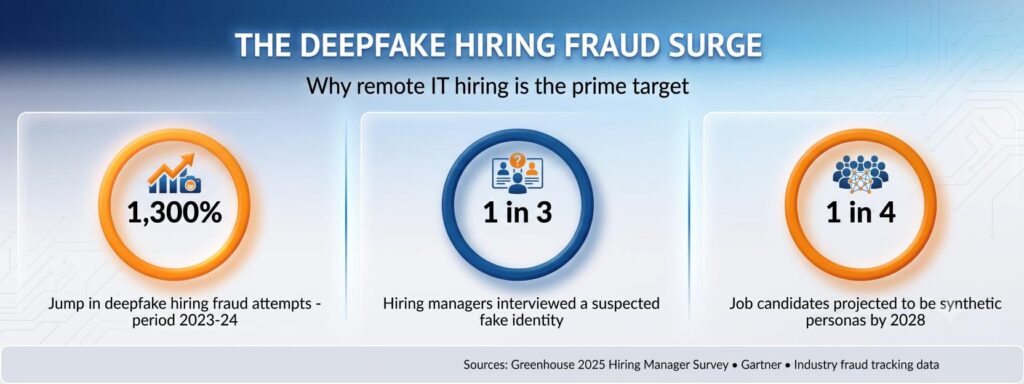
It gets heavier from there. The Department of Justice has prosecuted organized networks placing IT workers under false identities specifically to route enterprise salaries to sanctioned regimes. This isn’t a lone opportunist gaming a screening call. In fact, for some of these cases, it is a national security and compliance problem wearing a company badge.
High-paying, remote-first, fast-moving technical roles are exactly the ecosystem this fraud was built to exploit. If you are staffing IT talent remotely, you are the target market.
Why Your “Airtight” Screen-Sharing Fix Doesn’t Work
Once a company realizes it might be interviewing a ghost, the instinctive reaction is to add friction: “We’ll make them share their screen during a live coding test. Then they can’t Google the answers.”
It sounds clever. It is about as airtight as a screen door on a submarine.
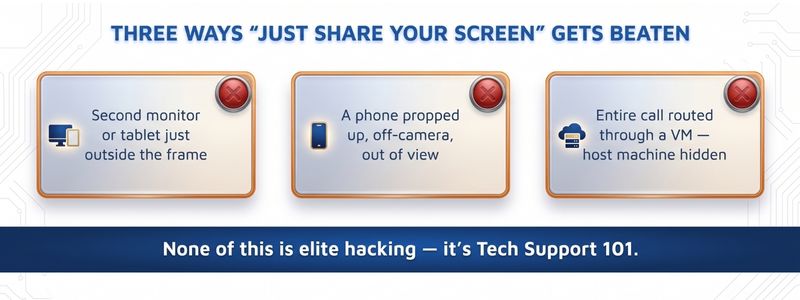
None of this requires elite hacking skill. It is within easy reach of exactly the technical candidates this fraud is designed to mimic.
The Collateral Damage of “Gotcha” Hiring
There is an additional cost to paranoid screening tactics that most companies miss entirely: your best candidates hate being treated like suspects.
When an interview feels like a federal interrogation, legitimate, high-caliber engineers simply opt out. They have other offers. The net result is a process that fails to catch the sophisticated fakes while quietly alienating the humans you actually want to hire.
Defeating the Phantoms: What Actually Works
You can’t solve a human-centered fraud problem with a software gate alone. It takes layered, behavioral verification built into the rhythm of the interview itself:
- Structured, project-based questioning. Skip generic technical definitions. Ask for the specific, messy details of a real project. A fake persona can recite documentation, but it can’t convincingly improvise the chaos of a failed legacy migration.
- The deconstructive follow-up. Scripted or coached answers rely on a predictable rhythm. When a candidate gives a flawless response, pivot immediately with an unscripted “why that architecture, not the other one?” Watch how they think, not just what they say.
- Identity cross-verification across the whole timeline. Stop treating the resume, the video call, and the onboarding paperwork as separate silos. Cross-check location details and identity data throughout the process. Fraud thrives in the cracks between disconnected HR steps.
These tactics work best alongside strong first-line screening. For the full list of behavioral tells to watch for on the call itself – mismatched lip sync, frozen eye lines, scripted-sounding answers to unscripted questions – see our companion post, How to Spot Deepfakes in Job Interviews.
Where iShift Fits: Real Humans, Real Vetting
At iShift, we’d argue that keyword-matching algorithms and hands-off video screenings are a big part of why deepfake hiring fraud has exploded in the first place.
Every candidate we consider is held to an uncompromising standard before a client ever sees a name. Our own technology experts conduct the technical interviews directly — no shortcuts, no automated parsing — and we vet for consistency across the entire timeline, so the person who signs the contract is the same person who writes the code.
It takes more intent than a keyword match. It’s also why the professionals we place hold up once the real work starts.
Is your remote technical screening built to catch a phantom — or just to make it inconvenient to be human?
Let’s look at your current process, find the blind spots, and make sure your next hire is entirely flesh and blood.

Fraud evolved. Your hiring process should too.
The cost of a bad hire just went up. Deepfake candidates, proxy interviews, and AI-assisted cheating are no longer edge cases, they are the new baseline. iShift’s Tech Talent team places pre-vetted IT talent across cloud, cybersecurity, data, and infrastructure, with a screening process built to surface the real thing before they reach your client.