
Summary: Margins are thin and Medicaid cuts are coming. The workforce is stabilizing, not fixed. Attackers are getting in through vendors. HIPAA and CMS rules are tightening. Legacy infrastructure is hitting expiration dates. AI adoption has outrun AI governance. And rural and community care just got a one-time budget. Each of these has a technology answer. None of them is a product you can buy off a shelf.
In 2023, we wrote that healthcare organizations felt like they were chasing a moving target while reimbursement shrank. The target is still moving. It is moving faster and there is less money behind the chase.
Three years on, the pressures have changed shape. Margins are thin and about to get thinner. Staffing has stabilized without being solved. Attackers have learned that the easiest way into a health system is through the vendor that processes its claims. Regulators are rewriting the rules. And AI went from pilot to production before most organizations wrote the policy that governs it.
Below are seven challenges shaping healthcare IT in 2026, what the current data says about each, and how healthcare leaders can build a unified response.
1. Thin margins, with Medicaid cuts on the way
Kaufman Hall’s October flash report found 43% of hospitals operating in the red. This up from 33% before the pandemic. In addition, Becker’s has tracked 68 hospitals and health systems announcing job cuts in 2026.
The bigger test has not landed yet. HR 1 cuts nearly $1 trillion from Medicaid. Hospital leaders cite Medicaid reimbursement of about 71 cents on the dollar dropping to 64 cents once the law takes effect.
The IT consequence is predictable. When margins compress, the budget lines that go first are the ones that do not produce revenue this quarter: modernization, security, and cleanup of infrastructure nobody wants to touch. Deferring them does not save money. It is a loan and the interest shows up in the next few sections.
2. A workforce that is stabilizing, not fixed
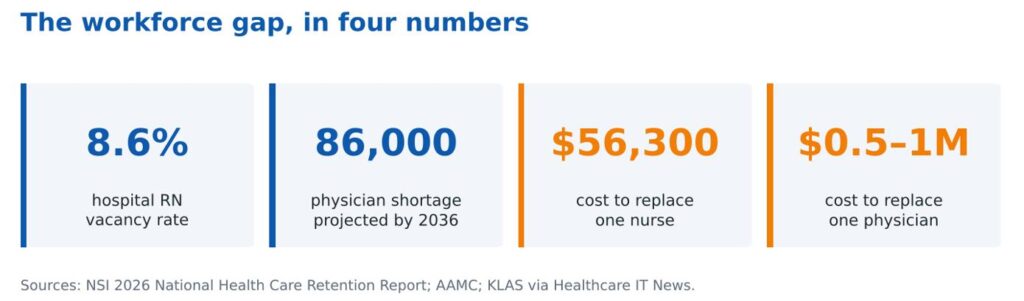
Healthcare hiring is back near pre-pandemic norms, and “normal” still means about 1.47 million open jobs as of April 2026. NSI’s 2026 survey put the national hospital RN vacancy rate at 8.6%, with a third of hospitals (33.1%) at 10% or higher. The physician gap is the slower problem: the AAMC projects a shortage of up to 86,000 physicians by 2036.
Burnout is the part with real progress. AMA data show 41.9% of physicians reporting at least one burnout symptom in 2025, down from 48.2% in 2023. Technology is part of the reason. A JAMA Network Open study of two large systems found ambient AI scribes associated with a 21.2 percentage-point absolute reduction in burnout at Mass General Brigham after 84 days. The caveat that belongs in the room: these were pilot users, and survey response rates were 22% and 11%, so the results skew toward people who liked the tool.
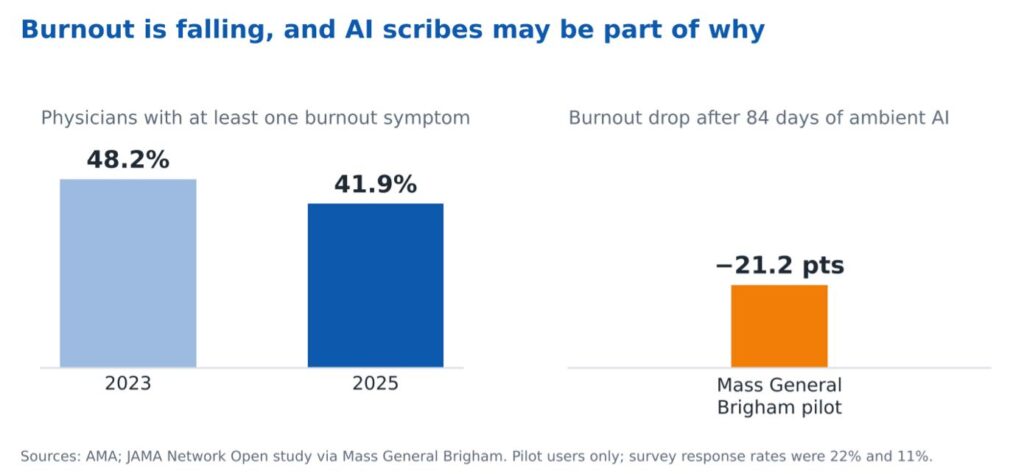
Turnover is where the money goes. KLAS puts the cost of replacing a nurse at about $56,300 and a physician at $500,000 to $1 million. Retention is the cheaper line item.
3. Your biggest cyber risk is probably a vendor
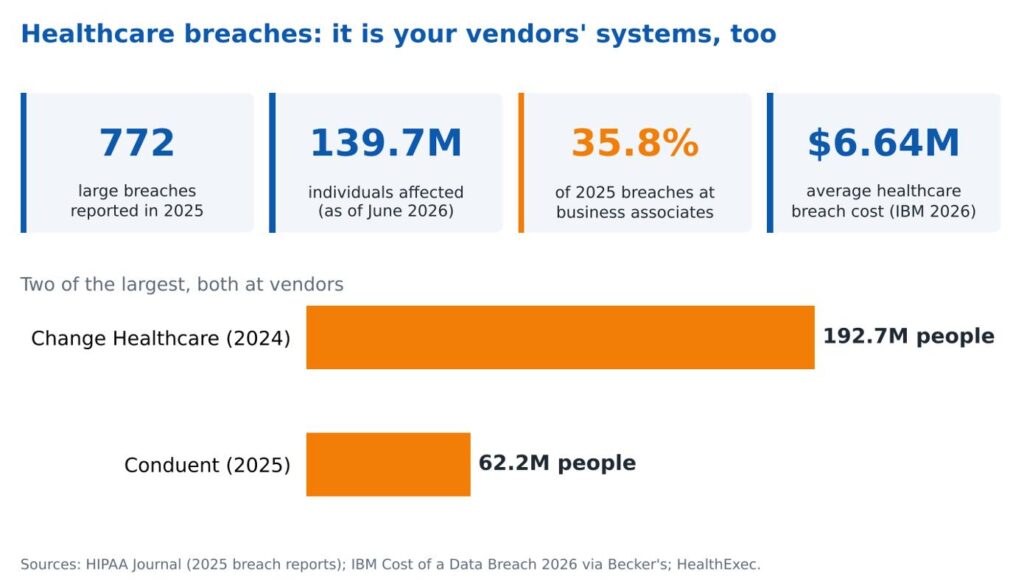
Large breaches reported to HHS hit a record 772 in 2025, and about 139.7 million individuals were affected as of June 2026, with the total still climbing as investigations finish. More than 80% were hacking or IT incidents.
Look at who got hit. 35.8% of 2025 breaches occurred at business associates, and the largest of the year, Conduent at 62.2 million people, was one. The largest ever, Change Healthcare at 192.7 million, was blamed on a single legacy server that lacked multifactor authentication. Those are your vendors’ systems and they are also your patients’ records.
IBM’s 2026 report puts the average healthcare breach at $6.64 million, down 10.5% from last year and still the most expensive of any industry. Regulators care less about the invoice than the paperwork: 76% of OCR’s 2025 enforcement actions included a penalty for a risk analysis failure, and OCR has said its 2026 focus extends to risk management, meaning proof that you reduced the risks you found.
Notice what these failures have in common. They are ordinary. A legacy server with no MFA. A risk analysis that never got finished. Security that stops at your own network edge while the data lives somewhere else.
4. Compliance clocks: the HIPAA Security Rule and CMS-0057-F
HHS has proposed the biggest rewrite of the HIPAA Security Rule in more than 20 years, which would make controls like multifactor authentication and encryption required instead of “addressable,” alongside network segmentation standards. After roughly 4,700 comments, and with more than 100 hospital systems and associations asking HHS to withdraw it, final action has slipped to July 2027.
That date is itself an estimate, and a final rule would start a 180-to-240-day compliance window, which puts realistic compliance in 2028. Do not read the delay as a reprieve. Analysts note that most of the proposal codifies practices a reasonable security program already has, and OCR is enforcing risk analysis and risk management under today’s rule.
The other deadline sits on the payer-provider boundary. Under CMS-0057-F, payers had to meet new prior authorization timelines starting January 1, 2026, and must stand up FHIR-based Prior Authorization and Provider Access APIs by January 1, 2027. Providers have to connect to those APIs, and in one industry survey fewer than half (47%) said they were somewhat or very likely to meet the January 2027 deadline.
5. Infrastructure that is aging out
Windows 10 reached end of support on October 14, 2025. Medical devices are where that hurts. Australia’s TGA warns that devices still depending on it may be open to unauthorized users or malicious actors. Furthermore, if a device’s hardware can’t run Windows 11, the manufacturer has to tell customers and offer an alternative. Even in the UK, where NHS trusts were told to upgrade, some device makers have told buyers to replace equipment that is only three years old.
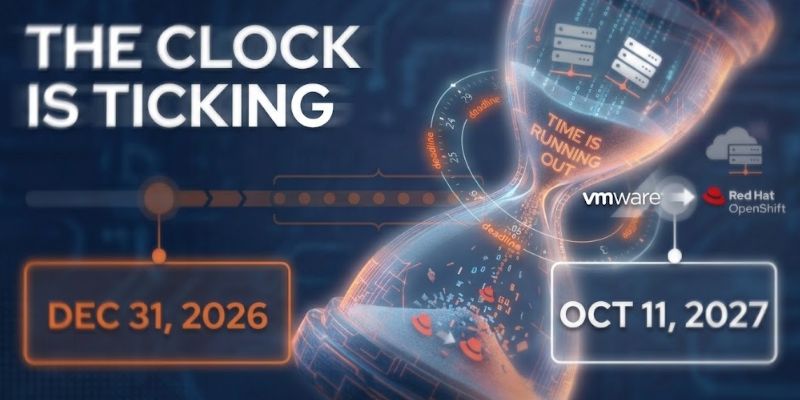
Virtualization has its own clock. Broadcom’s published date for end of general support for vSphere 8 is October 11, 2027. If your clinical or back-office systems run on VMware, that is a deadline, not a suggestion, and migrations of that size do not start in September 2027.
Unsupported does not mean unusable. It means unpatched, and unpatched systems on a flat network are exactly the kind of foothold attackers look for.
6. AI is moving faster than the governance around it
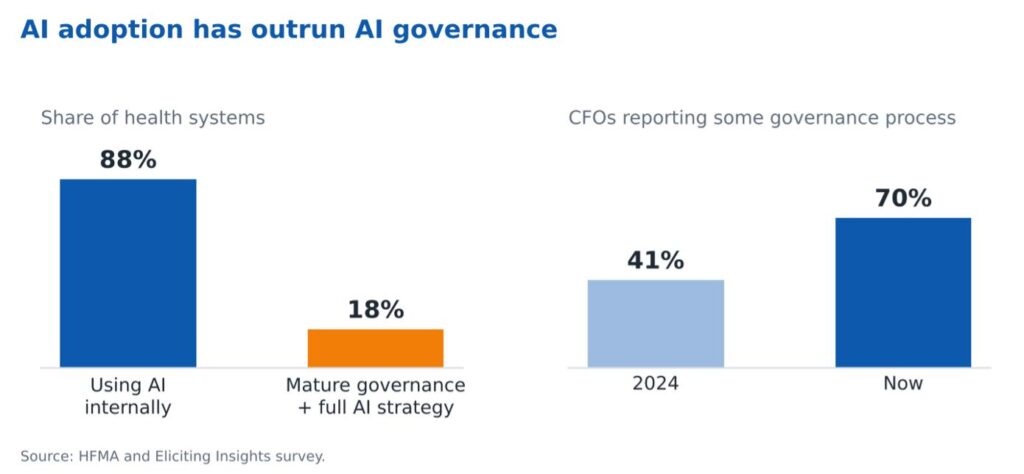
An HFMA and Eliciting Insights survey found that 88% of health systems are using AI internally, but only 18% have a mature governance structure and a fully formed AI strategy. More than 80% say they lack the resources to identify, select, and implement AI solutions, and more than a third of systems investing in AI have no formal data policy for it.
That is improving: 70% of CFO respondents now report some governance process, up from 41% in 2024. But “some process” is not the same as a policy that says what an AI tool may see. In healthcare that question has teeth because the data involved is usually protected health information.
A useful rule: an AI pilot is never only a model. Someone builds it, someone decides what data it can access, and someone makes it something you can deploy more than once. A pilot that skips the last two is a demo.
7. Care beyond the hospital walls, and a one-time budget to fund it
Three years ago, we wrote about taking care to the patient and giving patients easier access to care. The money to do more of it just arrived, with conditions. In December 2025, CMS announced $50 billion in Rural Health Transformation awards over five years, $10 billion a year from 2026 through 2030. First-year awards run from $147 million to $281 million per state, and the program’s priorities include modernizing rural health infrastructure and technology.
Read the fine print. The same legislation is projected to reduce rural funding by $155 billion over 10 years. Treat the $50 billion as a bridge, not a baseline: spend it on things that lower your run-rate costs, such as automation, consolidated platforms, security that does not require a full-time hire, rather than on things that raise them.
How iShift helps healthcare organizations move forward
The challenges outlined above compete for the same capital and the same overburdened teams. Tackling them requires a unified execution model: remove immediate operational risks, eliminate waste to fund security and modernization, and stand up delivery capacity without adding fixed payroll overhead.
iShift organizes this support across three practical pillars:
- Modernize Infrastructure and Control Run-Rate Costs
- VMware Exit Migration & Proof of Value (PoV): Evaluate platform alternatives across Red Hat, Nutanix, Hyper-V, and cloud targets before the vSphere 8 end-of-support deadline. Test live workloads, backup validation, and failover in a sandboxed PoV environment before signing multi-year commitments.
- Cloud Migration Factory & Automation: Migrate legacy clinical and operational workloads using repeatable automation that avoids bespoke one-off refactoring costs.
- FinOps and Governance: Continuously identify idle resources, right-size instances, and enforce infrastructure policies to protect margins as reimbursement tightens.
- Strengthen Cyber Resilience, Third-Party Risk, and Compliance
- Virtual CISO (vCISO): Deliver executive security leadership to direct incident response planning, run board-level reporting, and oversee third-party vendor risk assessments where breaches most frequently originate.
- iCompli Platform: Replace point-in-time annual audits with continuous control monitoring, automated evidence gathering, and clear alignment with proposed HIPAA Security Rule updates and OCR risk management mandates.
- Identity and Zero Trust Access: Implement least-privilege access, multifactor authentication, and network micro-segmentation to isolate legacy medical devices that cannot be patched or replaced.
- Put Data, Practical AI, and Tech Talent to Work
- AI Readiness & Policy Governance: Audit data infrastructure and establish operational access policies before deployment, ensuring sensitive protected health information remains shielded from unauthorized model visibility.
- Intelligent Automation: Deploy automated workflows to streamline repetitive administrative burdens, prioritize prior authorization requirements, and curb staff burnout.
- Tech Talent on Demand: Overcome healthcare IT hiring bottlenecks with vetted senior specialists across cloud, security, data platforms, and AI deployed in three to five business days.
The starting point is your organization’s most pressing operational problem. From there, we help build a practical roadmap with clear priorities, accountable owners, and measurable outcomes.
Where to start
You do not need to solve all seven. You do need to know which ones are yours. Four moves that pay off regardless:
- Finish a current, documented risk analysis, vendors included. It is the most-penalized gap in OCR enforcement and the foundation for everything the proposed Security Rule would require.
- Inventory your end-of-support exposure. Windows 10 endpoints and devices, and anything running vSphere 8, with a date next to each.
- Write the AI policy before the next pilot. What data may a tool see, who approves it, and who reviews it.
- Pick the two or three investments that lower run-rate cost, and fund security and modernization from those savings instead of from deferral.
None of this is glamorous. All of it is cheaper to do on purpose than under pressure.
Want a second set of eyes? Book a consultation with a senior iShift executive to pressure-test your priorities and identify the next practical step.